As a School Group Manager you can create and distribute policies to groups across your trust. You can choose to send the policy to all schools, or to a selection of schools.
Log into your account and select the correct access level:
- Log into your School Group Manager account.
- Click on ‘Admin’ shown on the landing page at the top to the left of your profile icon.
- Click on 'Leadership & Governance' in the left hand navigation.
- Select 'Policy Manager'.
- To create as a School Group Manager ensure you have selected 'Group Admin' in the drop down to the left:
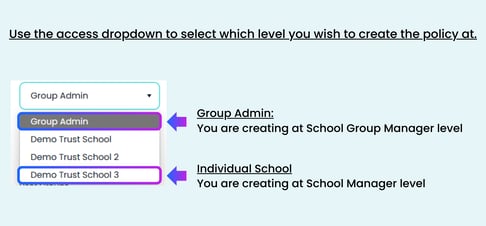
Click '+ Create policy':
- Click the
 button and select 'Statutory' from the pop up options.
 - Depending on the options you choose you will navigate through up to 5 steps to create the policy:
- You'll navigate through at least 4 steps in order to create the policy if you do not want to control the reading team:

-
If you as the Group School Manager want to assign the reading team, you'll navigate through 5 steps

1. Configure:
-
Use the dropdown to select the statutory policy you wish to create.
-
Click on the blue 'Policy Template' button to download the template.
- When the template opens, click on the 'Edit a Copy' button.
- Follow the steps shown within the document to customise the policy.
- Once your template is saved and downloaded/exported, attach it by clicking the 'Choose File' button.
- Fill out the 'Document name' field.
- Add the 'Review date' by clicking on the calendar icon - ensure this matches the review date stated in your template.
- Enter the 'CPD Hours'. This will add to the total CPD hours of all readers and approvers.
- Select who will be responsible for the policy from the drop down. You will be selected automatically but you can choose to unselect yourself. You can select up to 3 users to be responsible for the document.
- ℹ️ A Review Policy task will be added to the Task List of those with responsibility for the policy 28 days before the policy review date set in the steps above.
- Select the appropriate requirements by using the tick boxes.
- All statutory policies will have 'Requires approval' and 'Required on website' ticked by default.
- Selecting 'Limit visibility to...' means that only the approval /reading teams will be able to see this policy.
- Click 'Save and continue'.
2. Distribution
- Use the dropdown to select the schools that you wish the policy to be distributed to.
- Select if you would like the schools to be able to amend the Policy to make it relevant to their school:

ℹ️ If you want to assign the readers as School Group Manager in the next step, you need to select Non-Amendable.
- If 'Requires Reading' was previously selected, you now decide how you want the readers to be managed.

- Click 'Save and continue'.
3. Approval Team
ℹ️ All statutory policies require approval.- Search, filter by group using the drop down or select individuals from the left hand column.
- Click on the single, right hand arrow to add the selected individuals to the approval team.
- Select an 'Approval deadline' and click on 'Save and continue'.
ℹ️ Once the policy has been approved it will appear in the policy lists of the schools selected.
Only School Group Managers and School Managers can approve Group-Level policies
4. Manage Readers (If Group Admin Manages Readers was selected)
- Use the radio buttons to toggle between assigning either 'Individual Users' or 'User Groups' as the Reading Team.
- For Individual Users:
- Search, filter by group using the drop down, or select individuals from the left hand column.
- Click on the single, right hand arrow to add the selected individuals to the Reading team.
- For Individual Users:
-
- For User Groups:
- Use the drop down and tick against all the User Groups you wish to add to the Reading Team
- For User Groups:
- Select an 'Reading deadline'
- Click on 'Save and continue'.
5. Confirmation
- You will see a summary of the policy where you have the option to download or review.
- If you are you are happy with the details, click on the 'Publish policy' button.
- The assigned Approval Team will be notified and will see this within their Task List.
If 'Requires reading' is ticked and you want the schools to manage the reading, the  status will show in each school's policy list. The Reading Team will be assigned by School Managers within each organisation.
status will show in each school's policy list. The Reading Team will be assigned by School Managers within each organisation.